Aveilut ... אבלות ... Mourning
Caution: this is a long read. I began this piece 3 months after the death of my dad, and am only finishing it now. Grief takes time, and writing about it clearly takes a little longer.
On 30 August 2024, at 2am in the morning, my dear father Laurence Toltz, דוד בן ר׳ משה filled his lungs for the last time and departed this earth, in the presence of my mother, my sister and I. It had been a long ten days … the longest and saddest in my life. On his 82nd birthday, Al and I took mum and dad out for a celebratory breakfast at the top of the Shangri-La Hotel in Sydney. I knew dad would appreciate the incredible view of Sydney Harbour, a place that he loved more than anywhere else on earth. He grew up by the harbour. Back in the 1950s he sailed on it with his brothers, swam at Roseville Baths, explored the Kuringai bush by bike, and lived an idyllic, simple childhood. No fancy holidays, no extensive travel: just a joyful, free childhood in 1950s Australia.
This post is not a eulogy for my dad; that may come at some future point. Rather, this is an expression of gratitude for having the Jewish rituals of mourning that helped through this incredibly painful time. To be able to access these oriented me during the shock and suddenness of dad’s death. In publishing this description, I continue to process his loss.
On the evening of 19 August, the day of his 82nd birthday, dad collapsed at home. He had suffered a catastrophic injury from an aneurysm that had burst in his brain. For just over 10 days we sat by his beside: praying, talking to him, singing to him, hoping against hope that he would open his eyes and recognise us. It was not to be.
After dad died, we rang the Chevra Kadisha (the Jewish Burial Society), whose job it is to prepare the גוף (guf/body) for burial. At this stage, we entered the state of אנינה (anina) which the Rabbis describe as the most disorienting and distressing point of the grief cycle. Those in this state are not obliged to keep positive mitzvot that require attentiveness (for example, praying, reciting blessings, putting on tefillin), and are forbidden from eating meat, drinking alcohol, engaging in any celebrations or business. Nevertheless, it was allowable to go to Synagogue on Shabbes. On Saturday I attended Central Synagogue because I wanted to hear a choir. The Chazan, Rabbi Yehuda Niasoff, encouraged me to say Kaddish prior to my becoming officially an אבל (avel/mourner) after the burial. Rabbi Levi Wolf graciously acknowledged my presence and my status that day, and I continue to be grateful to them both for this kindness.
On the morning of the funeral, 1 September, I started to prepare mine and mum’s house for the שבעה (shiva/seven), the intense days of official mourning. These begin immediately after burial, and conclude on the morning of the seventh day, hence the name. Jewish tradition determines the start of day at twilight, so Monday itself counts as two days of shiva. Preparations in the house include finding a low seat for the mourners to sit, covering mirrors, and some people also cover photographs as well. The covering of mirrors is to indicate that the אבלים (plural of avel/mourner) disregard their appearance for the period of shiva; there is also a midrash that says that they are covered so that the grief is not amplified by gazing in one’s own reflection.
I dressed in a dark suit and white shirt (what i would wear to Shul on Shabbat and Yom Tov), had the last shower I would have until the end of Shiva, and gathered the family to travel to the cemetery. This cemetery is not owned by the state, but the Chevra Kadisha have an אוהל (ohel, literally tent, but colloquially one might call it a chapel or hall, not a synagogue) where the service was to be conducted. My dad loved Judaism regardless of denomination: my mum and sister wanted to have Rabbi Nicole Roberts from North Shore Temple Emanuel, as my parents had been long-time members. The Sunday prior to the funeral, the Rabbi had made time to talk to us in her office at the shul, and she gave a magnificent and appropriate הספד (hesped/eulogy) on the day.
When we arrived, we were given a knife to rend one of our garments (the picture of the shirt that links to this story). This became my clothes for the entire shiva - not to be laundered, not to be exchanged for a fresh shirt. There are limits as to what you should tear - it should not break any law of modesty, for example. After the service at the ohel, we walked behind the coffin while reciting Psalms and the צדוק הדין (Tsiduk haDin, a prayer that confirms the righteousness of Divine judgement), before filling the grave. Macquarie Park gravediggers do not fill the grave to cover the coffin, so we completed this before covering the grave with a board. Finally, after the recitation of קדיש (Kaddish, the prayer for the dead) we were greeted by those who attended with the traditional words:
המקום ינחם אתכם בתוך שאר אבלי ציון וירושלים
May the Almighty (literally “the Place”) comfort you, along with all other mourners of Zion and Jerusalem.
With these words, we were transformed into אבלים, joining all other Jewish men, women and children who were in mourning at this time. Once again, we were reminded of our connection to the people Israel, this time in grief.
We performed our first sitting at a reception at the ground afterwards.
Every night that week apart from Shabbat, we received friends in mum and dad’s home. We sat on low chairs, averted our eyes, and thanked people for coming. As well as the support and love of friends and family (who brought so much food that we still had leftovers for Shabbat), we had the support of many Rabbis from the various communities I have been affiliated over the years, Orthodox and non-Orthodox. I spent the week in a daze, as did mum and Haydee. I went to Shul for Shacharit (morning prayers) at Kadimah and Central, said Mincha (afternoon prayers) at home by myself, and had people over for Ma’ariv (evening prayers) as part of the Shiva. On the Shabbat morning before the end of shiva I attended Newtown Synagogue, where Rabbi Eli Feldman consoled me as I broke down for the last Kaddish. On the Sunday morning, mum and Haydee and I “rose” from our Shiva, and took a walk around the block, signifying its end.
Shiva is followed by שלושים (Sheloshim: 30), the 30 days of lesser grief. One returns to work, bathes again, and can begin to eat meat. The mourner continues to refrain from any joyous activities (and for children of the deceased, this lasts for an entire year). No concerts, no music beyond Synagogue, no parties. I didn’t miss these things at all - I had no energy to share in the joy of others. At all times I was surrounded by the support and love of friends and family, and I remain grateful for their steadfastness and comfort.
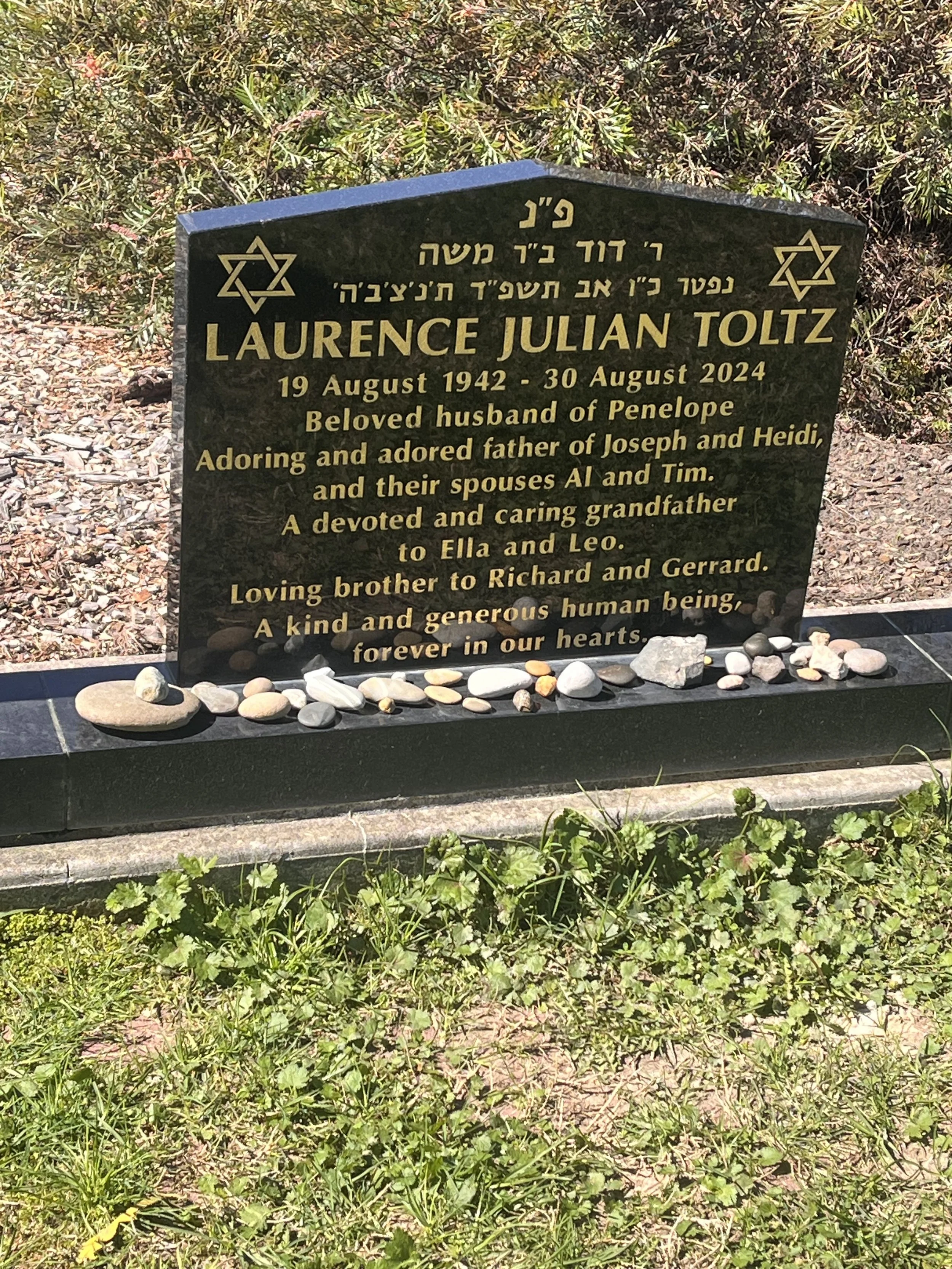
On the 30th day we went to the cemetery to visit the grave. The earth had settled somewhat, but our grief was reawakened. Over the following months, I would say Kaddish for Dad every time I was in Synagogue (at least 3 times a week, sometimes more). I came to understand the comfort and support of being in a minyan (a quorum of 10), with people who had lost their parents in years gone by.
The eleventh month is when children stop saying kaddish, and return to the ‘normality’ of life, forever changed.
On the anniversary of dad’s death, we consecrated his stone. Rabbi Jacki Ninio officiated for this service, and we each read a special eulogy for the day.
The pain is transformed by each step, each ritual. Surrounded by memories of joy, love, pride, support and kindness, it becomes easier to bear. But it never dissipates. Rabbi Acha bar Chanina said that when one attends to the sick, one takes away one sixtieth of the patient’s pain through the kindness of the act of visiting. Maybe it’s the same with the rituals and the ingathering of loved ones who support you through this time.
May Dad’s memory continue to be a blessing to all who knew him.